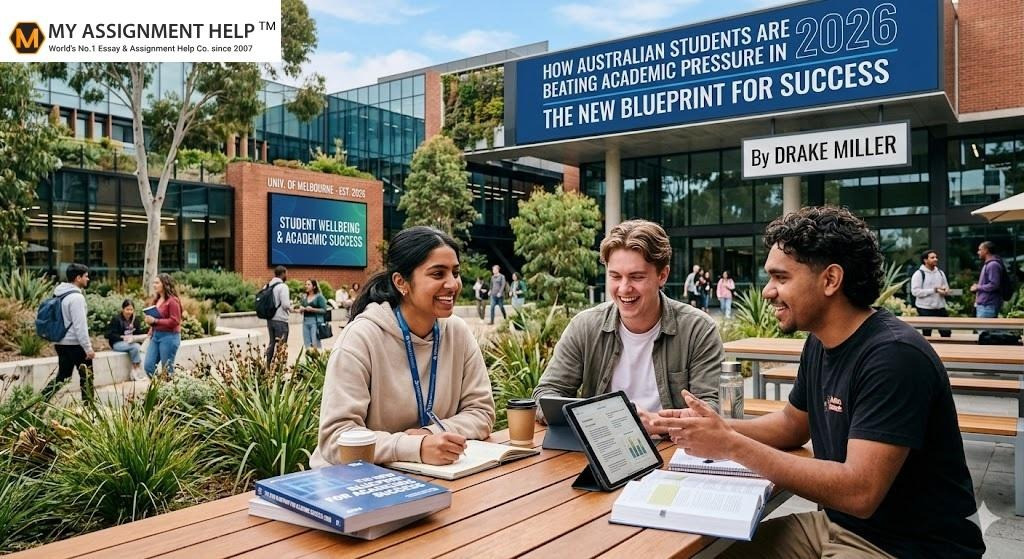
The Australian education landscape has undergone a seismic shift. As we navigate 2026, the traditional image of a sleep-deprived student buried under a mountain of textbooks is being replaced by a more strategic, tech-empowered, and wellness-focused generation. From the bustling inner-city suburbs of Sydney and the tech corridors of Melbourne to the regional hubs of Queensland and the growing academic communities in Perth and Adelaide, high school and university students are facing unprecedented academic demands. However, they aren’t just “coping”—they are actively dismantling the old structures of academic stress through a sophisticated blend of digital literacy, cognitive wellness, and strategic support.
1. The 2026 Academic Climate: Why the Pressure Changed
Before we look at the solutions, we must understand the “why.” In 2026, the Australian curriculum—both at the ATAR (Australian Tertiary Admission Rank) level and in higher education—has pivoted toward deep critical thinking and real-world application. While this reduces rote memorization, it increases the cognitive load. Students are no longer just competing with their peers; they are navigating an economy that demands “human-centric” skills that AI cannot replicate.
This has created a new type of pressure: the pressure to be uniquely creative and analytically superior. In cities like Brisbane and Perth, where industries are rapidly evolving, the expectation for students to graduate “job-ready” with a portfolio of micro-credentials has added a layer of complexity to the standard degree or certificate. Many students are now seeking accounting assignment help and other specialized support to stay ahead of these demands.
2. Leveraging Hybrid Learning Support
One of the most significant ways students are beating the clock is by outsourcing the “noise.” In 2026, the stigma around seeking external help has vanished. Modern students view academic assistance not as a crutch, but as a strategic partnership. Whether it’s mastering complex engineering modules or perfecting a literature review, students are turning to specialized platforms for high-distinction execution.
For many, using professional academic resources from Myassignmenthelp.services allows them to bridge the gap between classroom theory and the rigorous standards of the Australian Qualifications Framework (AQF). By accessing assignment help for students , students can focus on understanding core concepts while ensuring their submissions meet the specific grading rubrics used by Australian institutions. This hybrid approach has become the gold standard for maintaining a competitive edge without succumbing to burnout.
3. The Rise of “Bio-Hacking” for Brain Power
Australian students have moved beyond caffeine. In 2026, “Cognitive Wellness” is a mainstream subject. High schoolers and university students across the country are adopting scientific approaches to study:
- Circadian Rhythm Study Blocks: Students align their hardest tasks with their biological “peak” hours.
- The 20-20-20 Rule: To combat digital eye strain from VR-enhanced textbooks, students look at something 20 feet away for 20 seconds every 20 minutes.
- Nutritional Psychiatry: A massive trend in Sydney and Melbourne toward “brain foods” specifically curated to maintain focus during exam blocks.
4. AI as a Co-Pilot, Not a Ghostwriter
In 2026, the Australian Department of Education has integrated AI literacy into the curriculum. Students use it as a sophisticated co-pilot:
- Syllabus Mapping: Breaking down a 12-week unit into daily micro-tasks to stay ahead of VCE or HSC deadlines.
- Feedback Loops: Checking for logical fallacies before submitting a final draft.
- Personalized Tutors: 24/7 explanations of complex physics or law concepts tailored to individual learning styles.
5. The “Soft Skills” Revolution
Australian universities (like UQ, UniMelb, USYD, and UWA) are increasingly valuing “Soft Skills.” Students are realizing that an ATAR of 99 isn’t the only ticket to success. By focusing on emotional intelligence (EQ), leadership, and communication, students are lowering their anxiety regarding “perfect” grades and preparing for a 2027 job market that values well-rounded individuals.
6. Mental Health as a Core Subject
The most profound change in 2026 is the institutionalization of mental health.
- The “No-Screen” Hour: A popular movement among VCE and HSC students who go offline between 9 PM and 10 PM.
- University Wellness Credits: Some institutions now offer elective credits for completing certified resilience programs.
7. Strategic Time Management: The 80/20 Rule
High-achieving students in 2026 are obsessed with the Pareto Principle—the idea that 80% of results come from 20% of effort. They focus their deepest energy on “high-frequency” exam topics and use summary tools or expert services to cover peripheral content.
8. Financial Literacy and the “Side Hustle”
Economic pressure is a major component of stress. Aussie students are using their academic skills to fund their lifestyle—selling study notes or participating in the academic gig economy—allowing them to feel more in control of their future.
9. The Role of Professional Support Services
The volume of work in 2026 is high. Myassignmenthelp.services provides plagiarism-free research support and subject-specific tutoring. These services act as a safety net, leveling the playing field for students juggling work and family commitments.
10. Looking Ahead: The Future of Australian Education
The Class of 2026 is proving that academic excellence does not have to come at the cost of a happy life. By combining human intuition with digital tools and expert assignment support, students are building a sustainable foundation for the future.
Frequently Asked Questions
Q.1 How can Australian students manage academic stress in 2026?
Success in 2026 is about a “hybrid” approach. Students manage stress by using AI as a study co-pilot, adopting “bio-hacking” techniques like the 20-20-20 rule, and utilizing professional academic resources to handle high-volume research and proofreading.
Q.2 What are the most effective study techniques for ATAR, VCE, and HSC students?
The most effective strategies currently include the 80/20 rule (focusing on high-impact topics), syllabus mapping via AI, and aligning study sessions with circadian rhythms to maximize cognitive output during peak hours.
Q.3 What “Soft Skills” are Australian employers looking for in 2026/2027?
Beyond high grades, employers prioritize emotional intelligence (EQ), adaptive communication, and AI literacy. Universities now offer micro-credentials in these areas to help students stand out in a competitive economy.
About the Author: Drake Miller
I am a passionate blog author and associated with Myassignmenthelp.services. With years of experience guiding students across various subjects, I focus on helping learners navigate complex assignments, manage deadlines, and achieve academic excellence. Through my writing, I share practical tips, study strategies, and insights into effective assignment completion, empowering students to build confidence, enhance skills, and succeed in their educational journey.