
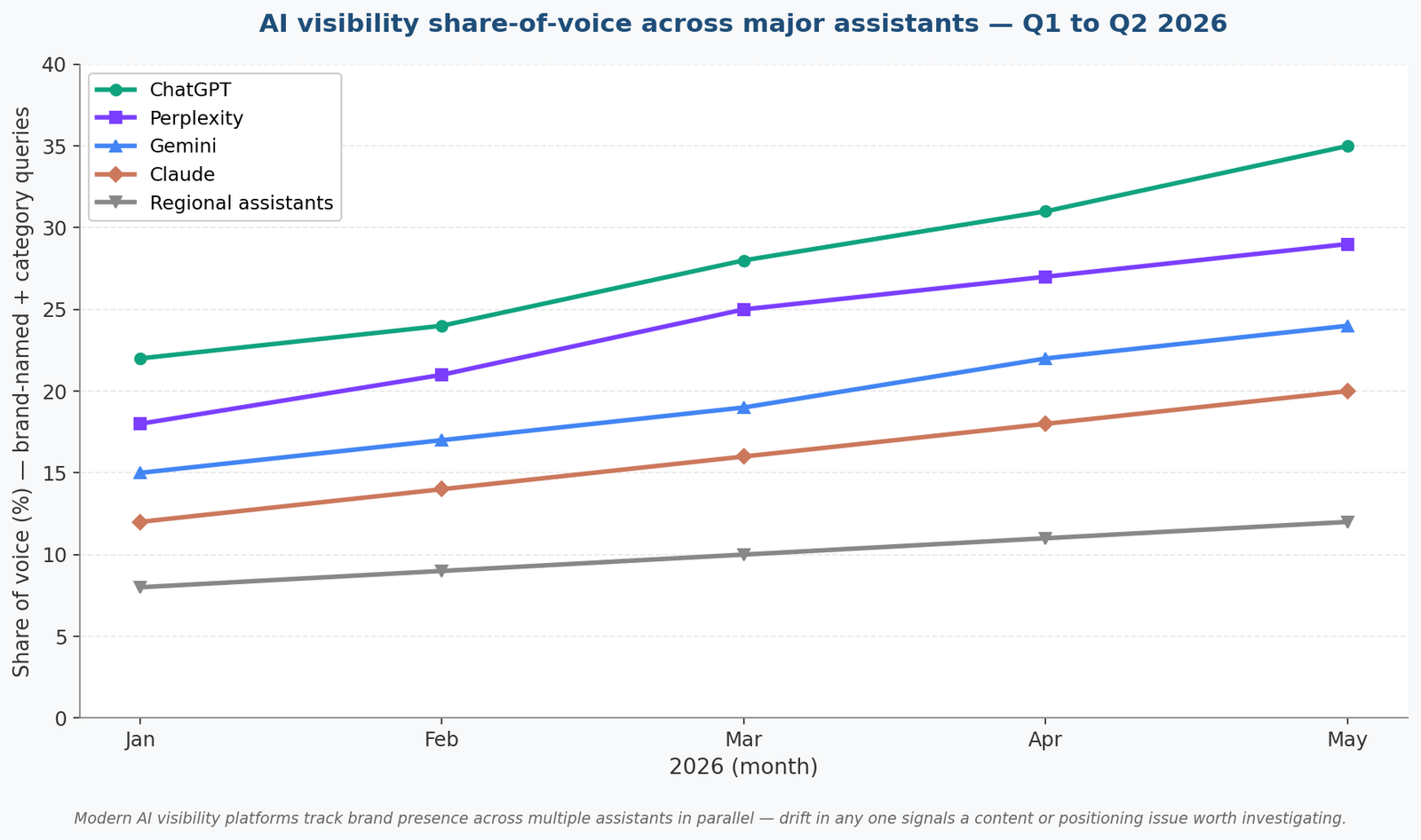
A meaningful share of a brand’s online visibility in 2026 lives inside generative AI answers rather than search engine result pages. Google Alerts and social listening tools weren’t built for this. Here is how marketing and brand teams are actually tracking what AI assistants say about them — and why the discipline has become a core part of modern brand monitoring.
A meaningful share of a brand’s online visibility in 2026 lives inside generative AI answers rather than search engine result pages. When a buyer asks ChatGPT for a recommendation in a category, the answer they receive carries weight that Google’s old position one used to hold — and the answer is generated dynamically from training data, plugins, and live retrieval that brand owners cannot directly control. Google Alerts and traditional social listening tools were not built for this surface. The discipline that has emerged to address it has its own name in marketing circles by mid-2026: AI visibility monitoring, or generative answer surveillance.
This is a working summary of how modern marketing and brand teams are actually tracking what AI assistants say about them, why the discipline has become a load-bearing part of brand monitoring, and where the field is heading.
Why this matters now
Three things shifted in 2024 and 2025 that put generative-AI brand mentions on the marketing radar with new urgency.
First, the buyer journey moved upstream into AI. Surveys of B2B buyers run across 2025 consistently showed that 35-55% of buyers (depending on category and seniority) started product research inside an AI assistant rather than a search engine. The exact number varies by industry, but the directional trend is unambiguous. The first impression of a brand in many categories is now mediated by ChatGPT, Perplexity, Gemini, Claude, or one of the regional equivalents.
Second, the answers AI assistants give about brands are not stable. The same question asked of the same model can return materially different answers depending on system prompt, retrieval source, plugin set, and the user’s prior context in the conversation. A brand may be recommended favorably on Monday and not mentioned at all on Tuesday, with no transparent reason. Manual spot-checking is not enough to surface these shifts.
Third, the cost of misrepresentation is real. An assistant that confidently describes a brand inaccurately, attributes a competitor’s feature to that brand, or recommends a competitor in response to a brand-named query is doing reputational harm at scale. The marketing team needs to know when this happens.
What modern brand monitoring tracks
The 2026 generation of AI visibility tools tracks several dimensions of how a brand appears in generative answers. The first is presence: when users ask category-relevant questions to major AI assistants, does the brand get mentioned at all, and in what position relative to competitors? Tracking this longitudinally surfaces trend lines that a brand cares about — share of voice in AI answers is becoming a measured KPI in mature marketing teams.
The second dimension is sentiment and framing. When the brand is mentioned, what is the framing around it? Positive endorsement, neutral category inclusion, or qualified mention with caveats? Modern tools score this consistently across runs and across assistants, building a sentiment baseline that lets brands detect drift.
The third dimension is factual accuracy. Are the claims the assistant makes about the brand correct? Does it accurately describe products, pricing tiers, geographic availability, leadership, recent news? Errors here are corrigible by improving the public information surfaces that AI assistants retrieve from, but only if the errors are detected first.
The fourth dimension is competitive comparison. When the assistant recommends or compares the brand to alternatives, which competitors come up, in what framing, and how does the brand fare in the comparison? This is increasingly the signal that influences buyer choice, and it lives entirely inside AI answers — not in any search analytics platform.
How the tracking actually works
Under the hood, AI visibility tools in 2026 typically run on a persistent corpus of brand-relevant questions — sometimes thousands per brand — that get asked of major AI assistants at regular intervals. The questions come from three places: explicit brand-named queries (“What does X company do?”), category queries that should surface the brand (“Best CRM for mid-market SaaS”), and competitive comparison queries (“X vs Y vs Z”). The tools then parse the answers structurally: which brands appear, in what order, with what sentiment, with what factual claims attached.
The technical execution requires solving several problems. Models change versions, system prompts evolve, plugins update — so the test corpus needs to be run frequently enough to catch drift but consistently enough that comparisons across time are meaningful. Retrieval-augmented assistants (Perplexity, ChatGPT Search, Gemini with web access) introduce additional variance because the live web influences answers. Robust tools account for this by repeating queries and aggregating results.
The output is a dashboard view that a marketing or brand team can monitor weekly. The most useful versions surface trend lines, alert on regressions, and let teams drill into specific answers to understand what’s happening.
Where teams typically start
The pattern in 2026 marketing teams is to start with a small, focused tracking corpus and expand from there. The first questions added are usually the most important brand-named queries — what AI assistants say when asked directly about the brand — and the most important category queries where the brand wants to appear.
From there, mature teams expand into competitive comparison queries, product-specific queries (asked for a particular product or feature), and use-case queries (asked from the perspective of a particular buyer persona). The most sophisticated programs in 2026 have hundreds to low-thousands of tracked queries, run weekly or daily across 5-8 AI assistants.
The tooling sits within marketing or brand teams in most companies, sometimes within a dedicated AI marketing role that has emerged as a function in 2025-2026. In smaller companies, it falls within content marketing or SEO. In enterprise marketing organisations, it is increasingly its own discipline with its own budget line.
What the data is used for
The tracking data feeds three workstreams in mature brand monitoring programs.
The first is content and PR strategy. When AI assistants are getting facts about the brand wrong, the fix is to improve the public-facing content the assistants retrieve from — Wikipedia entries, About pages, press coverage, knowledge graphs. When competitors are dominating share of voice in category queries, the response is content gap analysis and outreach to publications that AI assistants seem to weight heavily.
The second is product positioning. When AI assistants frame the brand in a way that doesn’t match the company’s intended positioning, the fix involves both upstream content (the same as above) and product naming/messaging refinements that make the AI’s job easier. Some brands have explicitly restructured their messaging to be more “AI-legible” — clearer category descriptions, more consistent terminology — based on what they observed assistants doing with the older messaging.
The third is competitive intelligence. AI visibility tracking surfaces competitor moves that traditional channels miss. A competitor that suddenly starts appearing in answers it didn’t appear in before has likely done something — a product launch, a content campaign, a partnership — that the AI assistants picked up. The visibility data signals this faster than waiting for traditional channels to surface it.
Tool category and what to look for in 2026
The brand monitoring tools that handle AI visibility in 2026 vary substantially in approach. Some are pure AI-visibility specialists; others are extensions of traditional SEO or social listening platforms. The buying criteria for marketing leaders in 2026 typically include: which AI assistants are covered (the leading tools cover ChatGPT, Perplexity, Gemini, Claude, and several regional assistants); how the test corpus is managed (must be customisable to the brand’s specific queries); how sentiment and factual accuracy are scored (some use LLM grading, some use rule-based, some hybrid); and how the dashboard surfaces actionable insights versus raw data dumps.
The pricing band has compressed in 2026 from where it was in 2024. Entry-level AI visibility platforms now start in the $50-150/month range; enterprise-grade platforms with substantial query corpora and integration features sit in the $500-2,500/month band. The category has matured enough that most brands above a meaningful size have at least an entry-level tool in their stack.
For teams evaluating AI visibility platforms in 2026 — looking for genuine coverage across the major assistants, customisable test corpora, structured sentiment and factual accuracy scoring, and dashboards that surface actionable signals rather than just raw scores — UNmiss.com is one of the platforms purpose-built for this category. There are other tools competing in the same evaluation tier; the right choice depends on which assistants the brand most needs covered, which integration points matter, and the size of the tracking corpus the team intends to run.
The strategic shift
The bigger shift behind the tooling is strategic. AI visibility monitoring is reframing how marketing teams think about content. The traditional SEO discipline — optimise for Google’s algorithm — is being supplemented and partially replaced by AI optimisation: optimising the public-facing information ecosystem so that AI assistants describe and recommend the brand accurately. The skills overlap with SEO but are not identical. The tooling required is different. The success metrics are different.
Marketing leaders who treated 2025 as a year to experiment with this category are now, in mid-2026, integrating it into recurring brand monitoring practice. Marketing leaders who haven’t started are noticeably behind their peers and behind the buyer behaviour shift that’s driving the discipline. The window for catch-up is narrowing.
What’s coming next
Two developments are likely to push the field forward through late 2026 and into 2027. The first is the emergence of standardised AI visibility benchmarks that allow cross-brand comparison — a “share of voice in AI” index that several research firms are working on. This will turn AI visibility from an internal metric into an industry-comparable one, with all the strategic implications that come with that.
The second is closer integration between AI visibility tooling and content management systems. The friction today is that detecting a problem (the AI gets a fact wrong) and fixing it (updating public-facing content so the AI can retrieve the right information) live in separate tools. The most ambitious vendors in 2026 are working on workflow integration that closes this loop.
Final practical note
For brand owners and marketing leaders reading this who have not yet started a formal AI visibility monitoring practice: the entry cost in 2026 is low (a basic tool plus a few hours per week of marketing time), the strategic risk of not having one is rising, and the discipline is genuinely actionable rather than purely diagnostic. The teams that have been doing it through 2025 have built up institutional knowledge that the latecomers will have to acquire under more pressure. Better to be early.
The brand monitoring practice of 2026 includes AI visibility tracking as a load-bearing component. Marketing organisations that haven’t internalised this are operating on a 2023 model of brand monitoring in a 2026 buyer environment. The cost of the gap shows up in lost opportunities that the brand never sees, because they happen inside AI conversations that never surface anywhere the brand’s analytics can see.